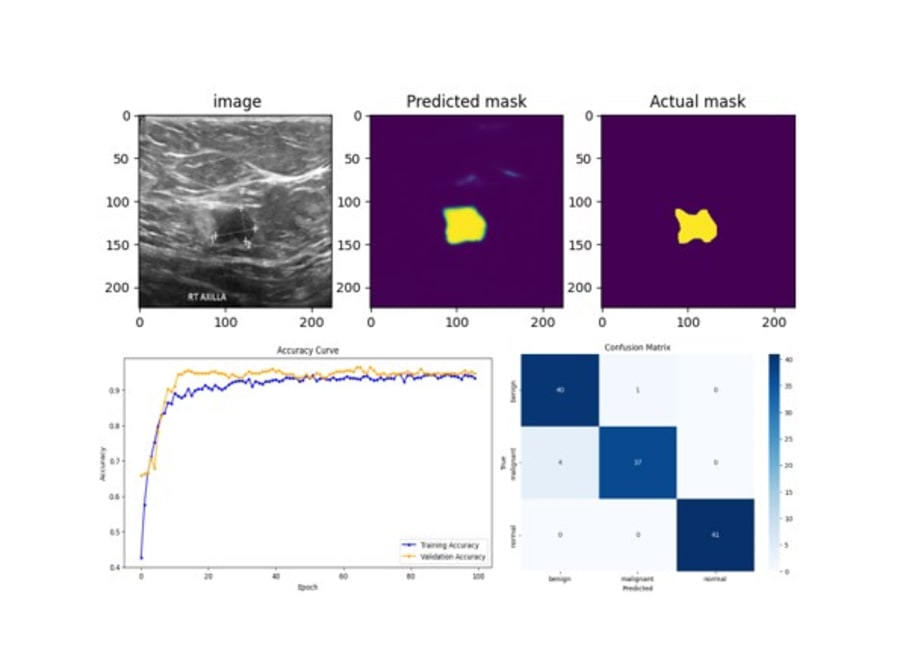
The project uses a two-stage pipeline. First, U-Net is trained on BUSI images with ground-truth masks to identify breast lesions. The generated lesion regions are then used to train a hybrid classifier for normal, benign, and malignant classes. Evaluation includes accuracy and loss curves, multiclass ROC analysis, a confusion matrix, and class-level performance metrics.
Projects
Selected projects in medical imaging, computer vision, deep learning, and applied artificial intelligence.
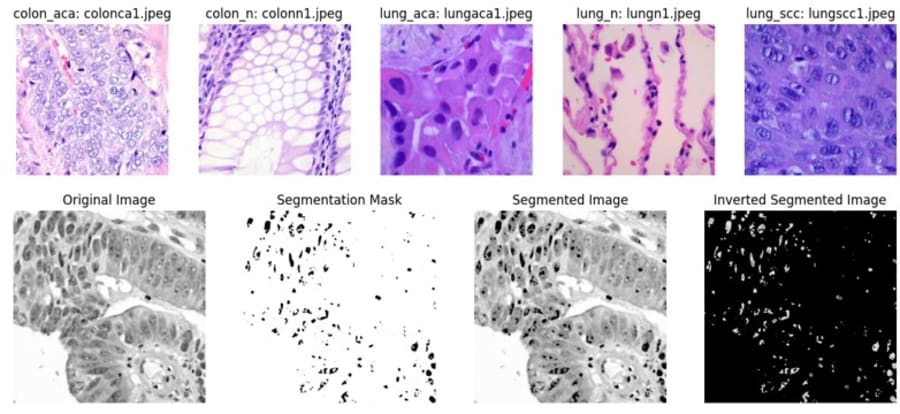
Sequential image-processing methods were applied to enhance circular nuclei and improve tissue representation. Image quality was evaluated through MSE, RMSE, SSIM, and PSNR. Five transfer-learning architectures—ResNet50, DenseNet121, EfficientNet-B0, MobileNetV3, and ViT-B/16—were compared using accuracy and F1-score, followed by an ablation study of the preprocessing workflow.
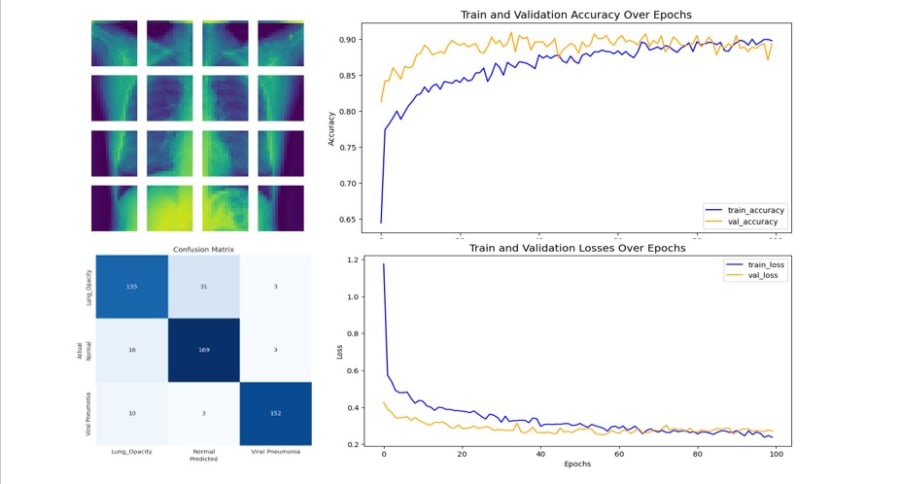
The workflow applies sequential preprocessing and quality-enhancement methods before classification with a Vision Transformer. Image quality and model performance are evaluated across the processing stages. The final experiment achieved 87% testing accuracy, indicating that carefully selected preprocessing methods can improve transformer-based medical image classification.